To properly evaluate display supplier options before placing a large order, assess production capabilities, material standards, structural testing, communication processes, and long-term scalability. The right retail display production partner should align with your brand goals, quality expectations, and operational timelines while meeting strict POP display quality standards.
Choosing a supplier for your retail floor displays is not just a procurement decision. It is a strategic move that directly impacts brand perception, in-store performance, and sales conversion. When you are preparing for a large production run, the margin for error disappears. A weak structure, inconsistent printing, or delayed logistics can affect entire campaigns.
If you are sourcing from a specialized manufacturer like diformainstore.com, your evaluation process must go beyond pricing and lead times. You need clarity, structure, and measurable criteria.
Here is how to approach it professionally.
1. Start with Strategic Fit, Not Just Price
Before requesting quotations, define your internal expectations. What is the objective of your display program? Are you launching a seasonal promotion? Rolling out across multiple retail chains? Testing a new product category?
A true retail display production partner should understand your campaign objectives, not just your die-line file. Ask:
- Do they specialize in retail environments?
- Have they worked with large-scale floor display rollouts?
- Can they support multi-unit distribution?
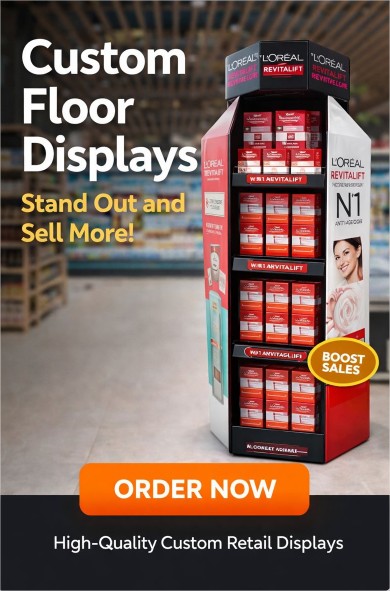
If your goal is high-visibility retail presence, explore examples of professionally engineered floor units such as those featured here:
https://diformainstore.com/floor-displays/
A supplier that already works within structured retail ecosystems will anticipate compliance, logistics coordination, and durability requirements.
2. Evaluate Engineering and Structural Integrity
Large orders magnify small mistakes. A display that performs well in a prototype phase may fail under real retail conditions if structural design was not properly validated.
When you evaluate display supplier options, request clarity on:
- Load-bearing capacity
- Reinforcement techniques
- Assembly efficiency
- Stability under repeated handling
Ask whether they conduct internal structural tests before mass production. Cardboard engineering is not just about cutting shapes. It requires knowledge of material resistance, folding mechanics, and weight distribution.

If you are considering corrugated solutions, review examples like:
https://diformainstore.com/cardboard-displays/
Professional cardboard displays must balance strength with cost-efficiency. The supplier should explain flute selection, board thickness, and reinforcement strategy clearly.
3. Confirm Compliance with POP Display Quality Standards
Quality in retail displays is measurable. Strong suppliers operate under defined POP display quality standards that cover:
- Print resolution consistency
- Color accuracy across production batches
- Die-cut precision
- Edge finishing
- Structural alignment
Request physical samples or previous production references. Inspect edges, corners, lamination finishes, and ink adhesion.
Also confirm:
- Are materials certified or responsibly sourced?
- Do they follow internal inspection checkpoints before shipment?
- Is there a documented quality control process?
A reliable supplier will not hesitate to explain their workflow from prepress to final packing.

LA BOULANGERE FLOOR DISPLAY

BRIANNAS FLOOR DISPLAY

BORGES FLOOR DISPLAY

Milo Floor Display

Fernleaf DUMP BIN DISPLAY

French Brioche Floor Display
4. Assess Production Capacity and Scalability
A prototype is easy. Scaling to hundreds or thousands of units is different.
Before placing a large order, verify:
- Monthly production capacity
- Lead times for peak seasons
- Backup equipment availability
- Workflow efficiency
Your retail display production partner must demonstrate operational stability. Ask how they handle unexpected volume increases. Do they subcontract? Or do they manage production internally?
Large-scale retail campaigns demand predictability. Delays affect distribution windows and retailer commitments. A serious supplier provides clear timelines and realistic buffers.
5. Analyze Communication and Project Management
The quality of communication often predicts production outcomes.
During early conversations, observe:
- Response time
- Technical clarity
- Willingness to clarify structural details
- Transparency about limitations
When you evaluate display supplier proposals, consider whether they ask strategic questions about retail placement, product weight, and consumer interaction. Suppliers that simply request artwork files may not be thinking long-term.
Professional project management includes:
- Technical drawings validation
- Assembly instruction review
- Pre-production sample approval
- Shipping coordination
You are not just buying displays. You are entering a collaborative production relationship.

Custom Retail Display Manufacturers
Ready to boost in-store impact?
Let’s design a customized POP display that makes shoppers stop, look, and buy. From concept to production, we bring your brand to life at the point of sale.
Tell us your product, retail channel, and campaign timeline — we’ll recommend the best display format.
What you’ll get
- Display concept aligned with your brand
- Material & structure recommendations
- Production-ready plan and timeline
6. Review Assembly Efficiency and Retail Practicality
Retail environments require speed. Store staff rarely have time for complex assembly.
Ask suppliers:
- How many steps are required to assemble the unit?
- Are instructions included?
- Is glue required or is it lock-tab construction?
- Can one person assemble it easily?
Displays that are difficult to assemble reduce retailer satisfaction and may compromise final presentation.
Well-engineered floor displays should prioritize ease without sacrificing durability.
7. Evaluate Logistics and Packaging Strategy
Shipping damage can destroy margins.
Request details about:
- Packaging format (flat-packed or pre-assembled)
- Protective wrapping
- Pallet configuration
- Export compliance if applicable
A supplier familiar with large retail programs understands distribution center requirements. Confirm they have experience handling bulk shipments without compromising structural integrity.
A strong retail display production partner will proactively discuss packaging optimization and freight efficiency.
8. Look at Portfolio Relevance, Not Just Aesthetics
Beautiful images do not guarantee production reliability.
When reviewing past work:
- Are displays structurally complex or basic?
- Do they show consistent finishing?
- Are they clearly engineered for real retail placement?
Examine whether the supplier demonstrates versatility across product categories and structural styles. Retail floor displays must adapt to weight, size, and consumer interaction patterns.
9. Clarify Long-Term Partnership Potential
If you are placing a large order, chances are you plan future campaigns.
Ask:
- Can they support design adjustments quickly?
- Do they maintain die-lines for reorders?
- Is there a structured archive system for repeat production?
The right retail display production partner grows with your brand. Long-term collaboration reduces development costs and improves efficiency.
10. Compare Value, Not Just Cost
The cheapest supplier is rarely the most efficient choice at scale.
When you evaluate display supplier proposals, compare:
- Material quality
- Structural reinforcement
- Production reliability
- Communication transparency
- Quality assurance processes
Low-cost production without strong POP display quality standards can result in reprints, retail rejection,
or structural collapse in-store. Those hidden costs exceed initial savings.

Choosing the right supplier for your floor display program is not about finding a vendor. It is about selecting a strategic production ally.
By carefully assessing structural expertise, operational capacity, communication standards, and compliance with POP display quality standards, you reduce risk and protect brand credibility.
If your project includes retail floor units or engineered cardboard solutions, reviewing specialized production capabilities is essential. Explore structural examples and production standards at:
https://diformainstore.com/floor-displays/
https://diformainstore.com/cardboard-displays/
A structured evaluation process transforms procurement into strategic advantage. When you select the right retail display production partner, you are not only placing a large order. You are building a retail presence designed to perform consistently, reliably, and profitably.
Choosing a reliable POP display supplier isn’t just about price or quality; it’s also about ethics and compliance. It’s worth working with partners who can demonstrate they operate under clear standards of integrity: responsible labor practices, transparent sourcing of materials, and anti-corruption policies. In short: partners who meet ethical compliance standards and can back them up.